
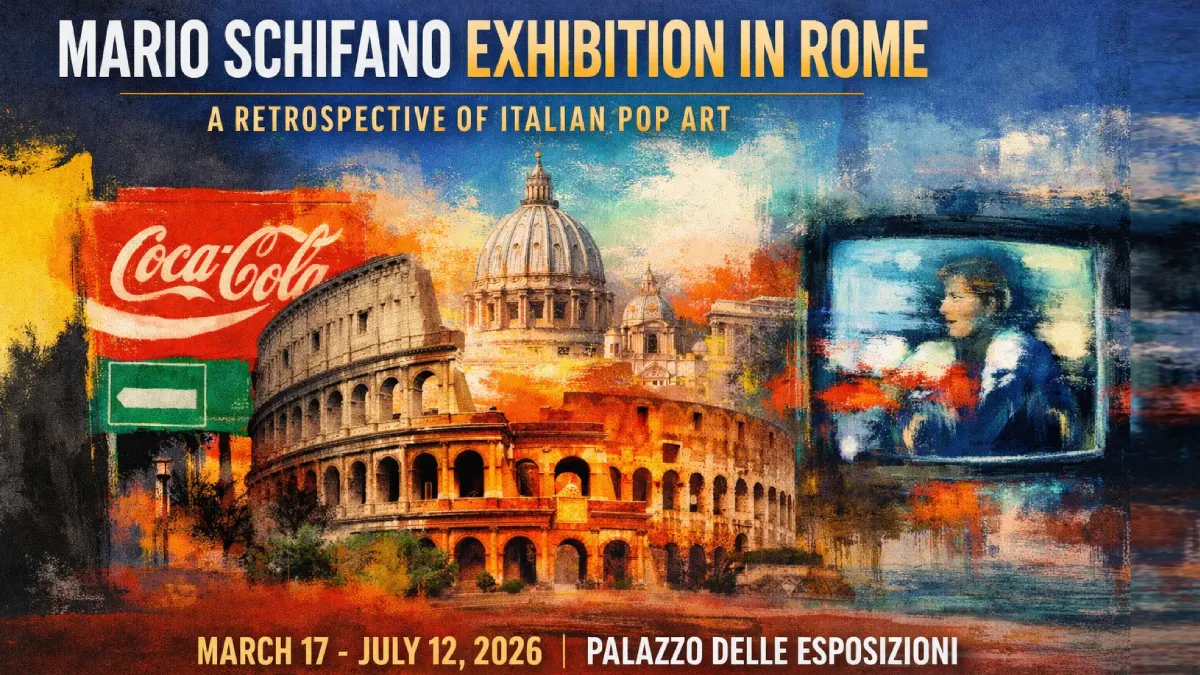
Rome is once again becoming a global hub for contemporary art. From 17 March to 12 July 2026, the city hosts a major retrospective celebrating Mario Schifano, one of the most influential figures in post-war Italian art.
Held at the historic Palazzo delle Esposizioni, the exhibition brings together more than a hundred works that trace the evolution of Schifano’s artistic language—from radical monochromes to experiments with photography, cinema, and television imagery.
For art historians, collectors, and cultural travelers from the United States, this exhibition provides a rare opportunity to explore how Schifano reshaped visual culture in the late twentieth century.
Why the Mario Schifano Exhibition in Rome Matters
Mario Schifano (1934–1998) is widely recognized as one of the pioneers of Italian Pop Art and multimedia experimentation. His work challenged the boundaries between painting, advertising, photography, and film.
The Rome retrospective aims to present the most comprehensive overview of his career, highlighting how he responded to the explosion of mass media and consumer culture.
Key reasons this exhibition is significant:
- Presents over 100 artworks from international collections
- Covers Schifano’s career from the early 1960s to the 1990s
- Explores the intersection of painting, photography, and television imagery
- Offers a deeper look at Italy’s Pop Art movement
For visitors planning Chicago to Rome flights or other travel routes, this exhibition is one of the most important cultural events in Europe in 2026.
The Venue: Palazzo delle Esposizioni
The exhibition takes place at Palazzo delle Esposizioni, one of Rome’s largest cultural venues located on Via Nazionale. The building has served as a major exhibition hall since its opening in 1883 and continues to host international art shows and cultural events.
Inside the venue, visitors will find:
- Seven large exhibition galleries
- A cinema auditorium
- Library and research spaces
- Cafés and cultural forums
For American travelers, the location is easily accessible from central Rome and close to historic landmarks such as Armando al Pantheon, a famous café and meeting place in the city.
Chronological Journey Through Schifano’s Career
The exhibition is structured chronologically, allowing visitors to follow the evolution of Schifano’s visual language over three decades.
Early Experiments and Monochrome Paintings (1960s)
Schifano’s early works are among the most radical in European painting.
During the early 1960s, he produced monochrome canvases using industrial enamel paints applied to paper mounted on canvas. These surfaces often appeared minimalist but were deeply connected to modern urban culture.
Characteristics of this period:
- Industrial enamel surfaces
- Minimal imagery
- Exploration of color fields
- Transition away from Informal abstraction
These works effectively functioned as visual “screens,” anticipating the role of images in media culture.
The Rise of Italian Pop Art
As the 1960s progressed, Schifano began incorporating symbols from everyday life into his paintings.
Examples include:
- Advertising logos
- Road signs
- Brand imagery
- Urban visual fragments
These elements reflected the rise of consumer culture and placed Schifano at the center of the Italian Pop Art movement, alongside artists associated with the School of Piazza del Popolo in Rome.
This approach mirrored what American artists like Andy Warhol were exploring—though Schifano’s work retained a distinctly European sensibility.
Media Experiments: Television and Photography
One of the most innovative sections of the exhibition focuses on Schifano’s experiments with television imagery.
By the late 1960s and 1970s, Schifano began:
- Photographing images from television screens
- Enlarging the images onto canvas
- Repainting them with rapid brushstrokes
This method allowed him to examine how mass media reshaped human perception.
Key themes explored:
- Media saturation
- Fragmented visual memory
- The relationship between reality and representation
These works anticipate many contemporary discussions about digital imagery and media culture.
The “TV Landscapes” Series
Among the highlights of the exhibition are Schifano’s famous TV Landscapes.
These works transform fleeting television images into painterly compositions.
Typical features include:
- Grainy photographic references
- Bright color overlays
- Expressive gestures across the surface
The result is a hybrid image that exists somewhere between photography, painting, and broadcast media.
Late Career and Multimedia Works
The exhibition concludes with works from the 1980s and 1990s, where Schifano increasingly integrated multiple media into his artistic practice.
These later works show:
- Experiments with cinema
- Expanded painting techniques
- Social and cultural commentary
The exhibition also includes film screenings dedicated to Schifano’s experimental cinema.
What Visitors Will Experience
The exhibition layout is designed to guide visitors through Schifano’s artistic biography.
Main sections include:
| Section | Focus |
|---|---|
| Early Works | Monochrome paintings and material experimentation |
| Pop Art Phase | Logos, signs, and urban imagery |
| Media Experiments | Photography and television integration |
| TV Landscapes | Hybrid media paintings |
| Late Works | Multimedia and socially engaged art |
This chronological structure allows viewers to understand how Schifano continuously reinvented painting in response to modern media.
Travel Tips for American Visitors
For U.S. travelers planning a cultural trip, Rome remains one of the world’s most accessible and safe destinations.
Common travel questions include “Is it safe to travel to Rome right now?” The answer is generally yes, as Rome maintains a strong tourism infrastructure and hosts millions of visitors annually.
Nearby educational institutions also attract international students, including:
- The American University of Rome
- American University of Rome acceptance rate discussions among U.S. applicants
Students studying art history often visit exhibitions like this as part of their academic research.
Cultural Context: Rome in 2026
Rome’s cultural calendar in 2026 is filled with major exhibitions and events celebrating modern and contemporary art.
The Mario Schifano retrospective stands out because it:
- Revisits the legacy of Italian Pop Art
- Explores the relationship between painting and media
- Highlights Rome’s role in shaping post-war visual culture
The show also reflects broader global conversations about imagery, perception, and mass communication.
Unexpected Cultural Parallels in Modern Media
Interestingly, modern visual culture—whether in sports, television, or digital media—echoes many themes explored by Schifano.
For example, the way audiences follow sports data today mirrors the media obsession Schifano explored decades ago.
Trending topics often searched online include:
- Rome Odunze stats
- Rome Odunze stats 2025
- DJ Moore stats
- Luther Burden
- Luther Burden III
- Luther Burden stats
- Colston Loveland
- Colston Loveland stats
- Caleb Williams
- Jim Rome
Just as Schifano transformed television imagery into art, modern audiences consume sports analytics, digital broadcasts, and media narratives at unprecedented speed.
Why This Exhibition Is Essential for Art Experts
For art historians and critics, the Mario Schifano retrospective offers several critical insights.
1. Reinterpretation of Pop Art
Unlike American Pop Art, Schifano’s work reflects a European philosophical approach to imagery.
2. Early Media Theory
His paintings predicted many issues surrounding digital culture, including:
- Image manipulation
- Media fragmentation
- Information overload
3. Cross-Disciplinary Innovation
Schifano moved effortlessly between:
- Painting
- Film
- Photography
- Television
Few artists of his generation explored such a broad range of media.
Visiting Information
Exhibition Dates:
17 March – 12 July 2026
Location:
Palazzo delle Esposizioni
Via Nazionale 194, Rome
Typical Opening Hours:
- Tuesday to Sunday: 10:00 AM – 8:00 PM
- Monday: Closed
Tickets can be purchased online or directly at the museum.
Final Thoughts
The Mario Schifano exhibition in Rome is more than a traditional retrospective. It is a powerful exploration of how art responds to modern media, consumer culture, and the rapidly changing visual landscape.
For American travelers, students from The American University of Rome, or art professionals researching twentieth-century movements, this exhibition offers an essential perspective on one of Italy’s most innovative artists.
From early monochrome canvases to television-inspired paintings, the show reveals how Mario Schifano transformed the language of contemporary art—and why his work remains profoundly relevant in the digital age.